
Scammers in Ghana Are Using AI Now: 7 Ways to Protect Your Business's MoMo

Photo: MTN MoMo stand, Korle-Klottey by Matti Blume, CC BY-SA 4.0, via Wikimedia Commons (cropped, with text added).
AI and Online Safety | By Royal Keita
Last week the Cyber Security Authority (CSA) was here in Cape Coast, presenting at the Central Regional Coordinating Council, and the number they shared made me stop scrolling: Ghana recorded GH¢209.7 million in losses from reported cyber incidents between January and September 2026. For the whole of 2025, it was GH¢22.5 million (Graphic Online).
That's almost ten times more, in nine months.
And here's the part that matters for anyone running a small business: the CSA now classifies AI-generated deepfake scams and brand impersonation as high-impact threats. Separately, on 12 October, the CSA's PRO told JoyNews that suspects in one ongoing investigation were "even adopting AI tools to be able to carry out some of these operations" (MyJoyOnline).
So this week I'm keeping it practical. No hype. Just what has changed, and what a shop, salon, chop bar or student hustle can do about it today.
What the numbers say
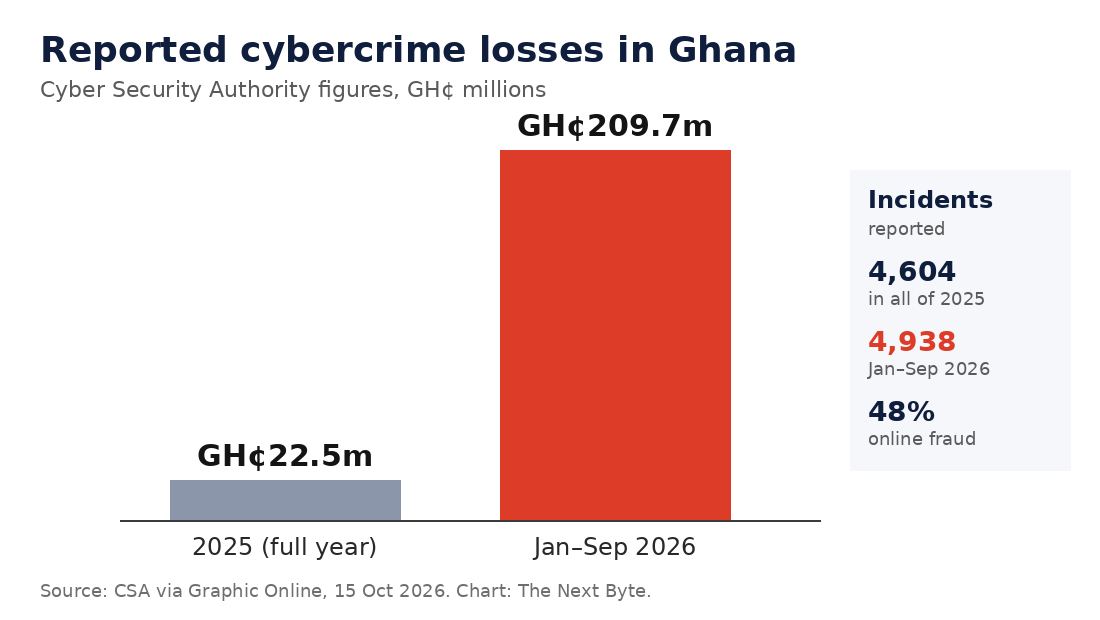
Chart: The Next Byte, using CSA figures reported by Graphic Online (15 Oct 2026).
- 4,938 cyber incidents were reported from January to September 2026, already more than the 4,604 for all of 2025 (CSA via Graphic Online).
- Online fraud is 48% of all reported incidents this year (same source).
- More than 90% of the scam cases analysed by the scam-number platform TrustGH involved getting a Mobile Money payment or getting into someone's MoMo account. About half of the 6,000+ scam numbers it has flagged were linked to TikTok (3News).
Remember, these are only the reported cases. The CSA itself says many victims never report. A lot of people lose money and keep quiet because they feel ashamed.
What AI changes
The old scams were easy to spot: bad grammar, strange accents, "you have won a promo". AI removes those clues.
- Cloned voices. A short voice note that sounds like your boss, supplier or sibling can now be faked.
- Deepfake videos. On 1 September, the Bank of Ghana and the SEC warned about a doctored video of President Mahama "endorsing" a crypto platform called Daily Wealth Guide. It wasn't real (BoG Notice BG/GOV/SEC/2026/27).
- Perfect messages. A fake order, invoice or "payment confirmation" can now be written in clean, professional English in seconds.
- Fake business listings and online shops. Fraudsters are also using e-commerce and fake contact details, with MoMo as the cash-out channel. JoyNews' #JoyGeekSquad explains how in the clip below.
Video: JoyNews on YouTube (embedded from the original).
7 rules for any business that takes MoMo
- An alert is not money. Check your actual MoMo balance before you release goods. Screenshots and SMS "alerts" can be faked, and AI makes the fakes look cleaner.
- Never share your PIN or OTP. Not with an agent, not with someone claiming to be MTN or Telecel staff, not with family.
- Verify money requests on a second channel. If your supplier sends a voice note asking you to pay a new number, call them back on the number you already have. That is exactly what CSA Director-General Dr Divine Agbeti asked of Ghanaians at the launch of this year's Cyber Security Awareness Month: "Verify before transferring money... Question unexpected requests for money. Even when the voice, message, or image appears to come from someone you know." (MyJoyOnline)
- Agree a family or team code word. Something only you know. If a "relative" or "staff member" calls in a panic asking for money and can't say it, hang up and call them back yourself.
- Claim your own Google and WhatsApp Business listings. If you don't control where customers find your number, a scammer can put theirs there.
- Be careful with "wrong transfer" stories. If someone says they sent money to you by mistake, don't send anything back yourself. Let your network handle any reversal.
- Check numbers, and report scams. Look up unfamiliar numbers on a scam-number checker before you pay a stranger, and report scams to the CSA: call or text 292, WhatsApp 0501603111, or email report@csa.gov.gh (CSA reporting page).
Why I'm building something about this
This one is personal for me. I'm building ScamCheck Ghana, a WhatsApp-first tool where you can check a number before you send MoMo and report one after a scam attempt, so the next person gets warned. It's still pre-launch, and I'll share the build here as it goes.
If AI is making scams cheaper to run, our checks need to be just as cheap and fast for ordinary people, right inside the apps we already use every day.
The takeaway
AI didn't invent MoMo fraud. It just made the lies sound more real. The fix is still the same old habit, done every single time: pause, verify, then pay. Share these 7 rules with the person who handles payments in your business, even if that person is you.
Curious how AI can work for your business instead of against it? Read my breakdown of Meta's new Muse Wonder model and what it means for Ghanaian SMEs.
Over to you: have you or someone you know been targeted by a MoMo scam this year? Tell me in the comments. Your story could help someone else spot the next one.
Sources: Graphic Online, 15 Oct 2026; MyJoyOnline, 12 Oct 2026; MyJoyOnline, 1 Oct 2026; Bank of Ghana/SEC notice, 1 Sep 2026; 3News, 31 Aug 2026; CSA incident reporting; JoyNews on YouTube.


Comments
Post a Comment